Sushruta: The First Plastic Surgeon in Human History
Shariq Ali
Valueversity
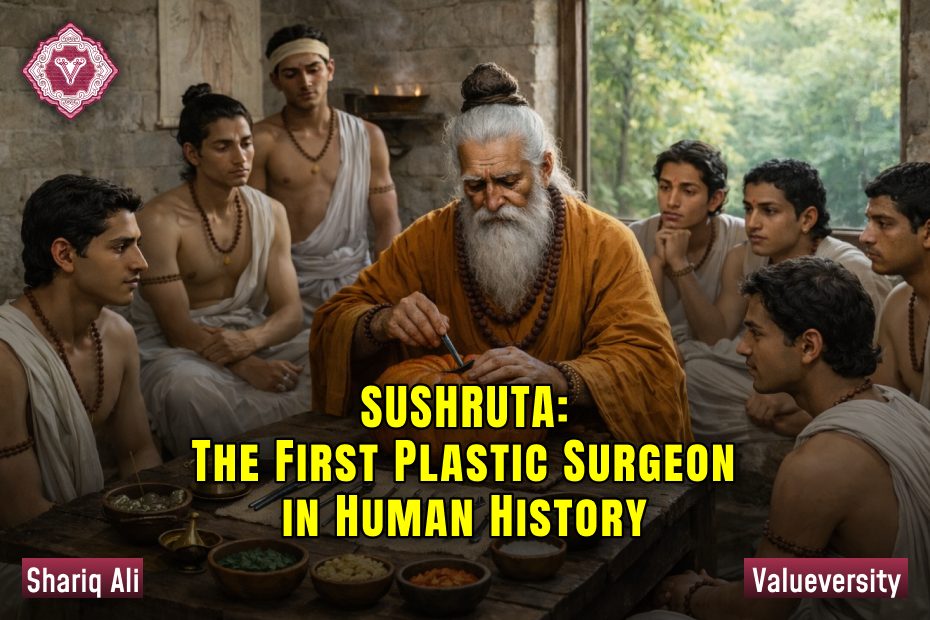
In the ancient city of Kashi, a few young students sat quietly in a room watching their teacher with great attention. The teacher was carefully slicing a pumpkin with a knife. This was no ordinary activity. He was training his students in the art of surgery. Smiling, the teacher said:
“Skill in surgery requires mastery of the hands, and mastery comes only through practice.”
That teacher was Sushruta, who is regarded in the history of medicine as one of the earliest great surgeons in the world.
Sushruta lived around 600 BCE in the ancient Indian city of Kashi (modern-day Varanasi).
He is often called the “Father of Surgery” because he systematically described the principles and practical methods of surgical practice.
His famous book, the Sushruta Samhita, is an extraordinary work of ancient medical literature. The text contains 184 chapters, descriptions of more than 1,100 diseases, about 300 surgical procedures, and nearly 120 surgical instruments.
Sushruta is particularly famous for describing a technique for nose reconstruction. In those times, cutting off the nose was sometimes used as a punishment for criminals. Sushruta explained how a new nose could be constructed using skin taken from the forehead—a remarkable advancement in the history of medicine.
He did not rely only on theoretical teaching but emphasized practical training for his students.
Practicing incisions on fruits and vegetables, and learning surgical techniques on dead animals, were early forms of what modern medicine today calls simulation training.
Sushruta also stressed the importance of cleanliness in surgery, proper preparation of instruments, and careful post-operative care of patients.
Interestingly, many of his ideas later traveled to the Arab world and from there reached Europe, helping to strengthen the foundations of modern surgery.
Thus, this teacher from thousands of years ago reminds us that the pursuit of knowledge and skill can carry humanity far beyond its own age.