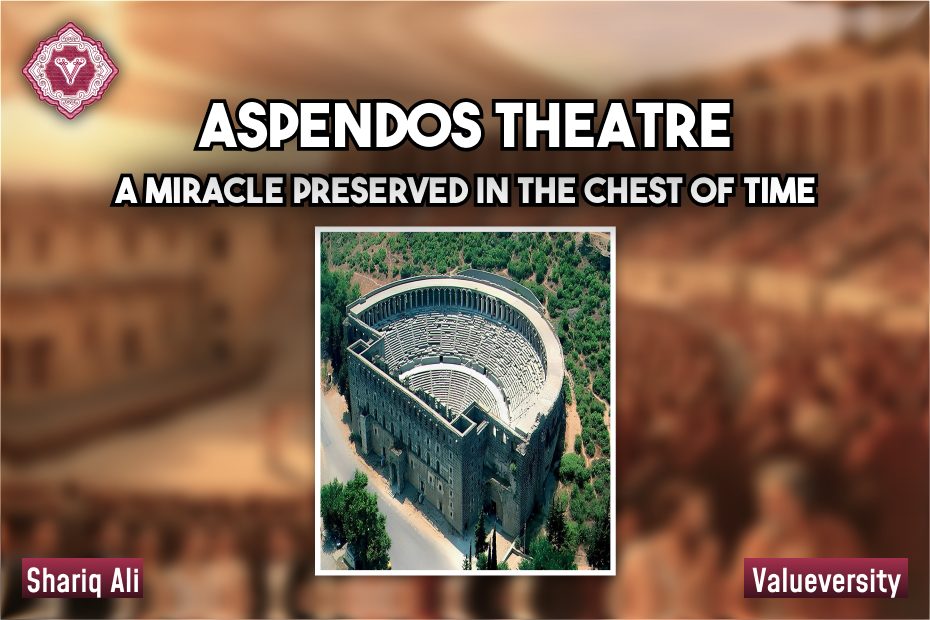
Aspendos Theatre — A Miracle Preserved in the Chest of Time
Shariq Ali
Valueversity
Just imagine…
An evening two thousand years ago.
The sun is setting. Thousands of people are seated on stone benches, and on the stage an actor delivers his dialogue without any microphone—yet his voice reaches the very last row with crystal clarity.
This is not a legend.
This is the reality of Aspendos Theatre.
Aspendos Theatre was built in 155 CE. It was part of the ancient Greco-Roman city of Aspendos, located in what is now the Antalya province of Turkey. Remarkably, it is considered one of the best-preserved ancient theatres in the world even today.
This magnificent structure was constructed during the reign of the Roman Emperor Marcus Aurelius, and its architect was Zenon— a Greek-origin master architect who himself was a resident of Aspendos. The project was financially supported by two wealthy brothers of the city, reflecting how highly art and culture were valued even in ancient times.
From an architectural perspective, Aspendos Theatre is a rare masterpiece.
Its diameter is approximately 96 meters, and it could accommodate seven to eight thousand spectators at a time. The theatre is partly built into a hillside and partly supported by high stone arches, presenting a beautiful blend of Greek and Roman architectural styles.
The most famous feature of this theatre is its extraordinary acoustics.
It is said that even if a person speaks softly while standing on the stage, the sound can be heard clearly in the last row. For this reason, architects and acoustics experts still regard this theatre as an engineering marvel. In ancient times, a large fabric canopy known as a velarium was also used to protect spectators from the sun—its traces are still visible today.
One major reason for the survival of Aspendos Theatre is its continuous use across different eras. In the thirteenth century, Seljuk rulers restored it and even used the stage building as a palace for some time. This ongoing use saved the structure from complete abandonment.
Even today, Aspendos
Theatre is not a silent ruin.
Every year, the Aspendos International Opera and Ballet Festival is held here, where modern performers appear on the same ancient stage—making it feel as though the past and the present are breathing together in a single moment.
A beautiful legend is also associated with this theatre.
It is said that the ruler of the city announced that whichever architect built the most magnificent structure would be allowed to marry his daughter. When the ruler stood in the last row of the theatre and heard a whisper spoken from the stage, he was astonished by Zenon’s skill—and the decision was made instantly.
Aspendos Theatre reminds us that
great civilizations are not recognized by power alone, but by knowledge, art, and the creative intelligence of human beings.
If, after two thousand years, a silent building can still teach us how to speak, then it is truly a living miracle of history.