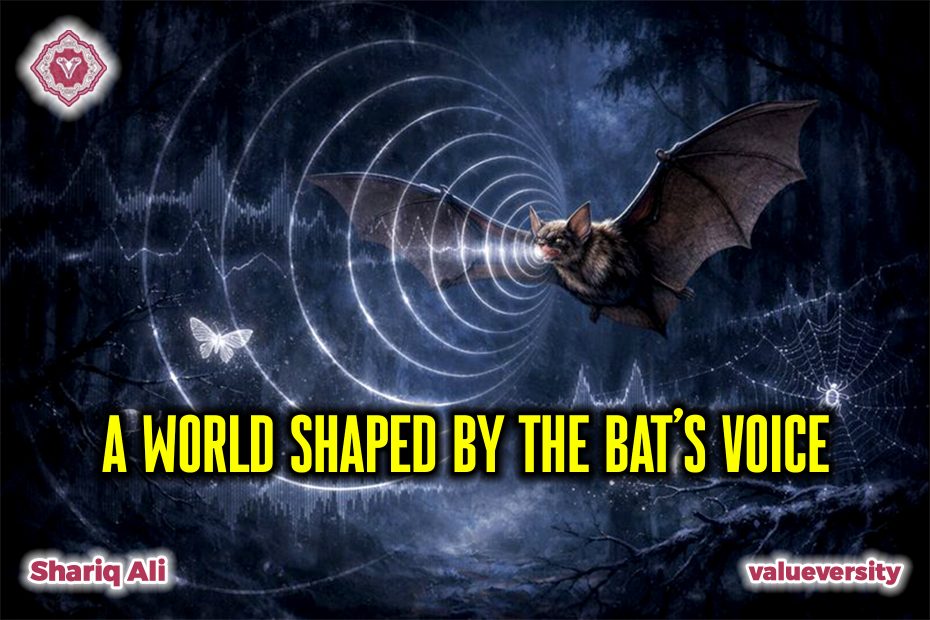
A World Shaped by the Bat’s Voice
Shariq Ali
Valueversity
Bats possess an astonishing ability to “see” in complete darkness.
Just imagine this:
The night is utterly silent; there is not even a trace of light. Yet in this pitch-black darkness, a tiny bat flies through the air with complete confidence. It does not collide with anything, does not lose its way, and does not miss its prey.
The question is: how does it see in such darkness?
The answer is truly remarkable:
the bat does not see with its eyes—it sees with sound.
A bat uses a natural sonar system known in scientific terms as echolocation. This is the same principle submarines use to navigate the depths of the ocean, but bats have been doing it for millions of years—without any machines.
A bat emits extremely fine, sharp sounds from its mouth or nose. These sounds are of such high frequency that humans cannot hear them at all. When these sound waves strike an object in the environment—such as an insect, a tree branch, or a wall—they bounce back.
This returning echo creates a complete map of the surrounding world in the bat’s brain. This map does not merely show where an object is; it also reveals whether the object is:
how far away it is,
whether it is moving or stationary,
soft or hard,
small or large.
In a way, a continuous sound-made movie is playing inside the bat’s mind every moment.
As the prey comes closer, the bat increases the rate of its sound emissions. At first, the sounds are like “ping… ping…”, and then suddenly they turn into a rapid “brrrrr.” This final stage is called the terminal buzz—the moment just before the final attack on the prey.
Astonishingly, some bats can detect and locate objects as thin as a human hair using sound alone. Darkness, fog, or complex surroundings—nothing becomes an obstacle for them.
This is a silent masterpiece of nature, teaching us a profound lesson:
to understand reality, having eyes is not essential;
a perceptive mind is enough.
Perhaps that is why the bat teaches us that
to truly see the world, we need less light—and more awareness.