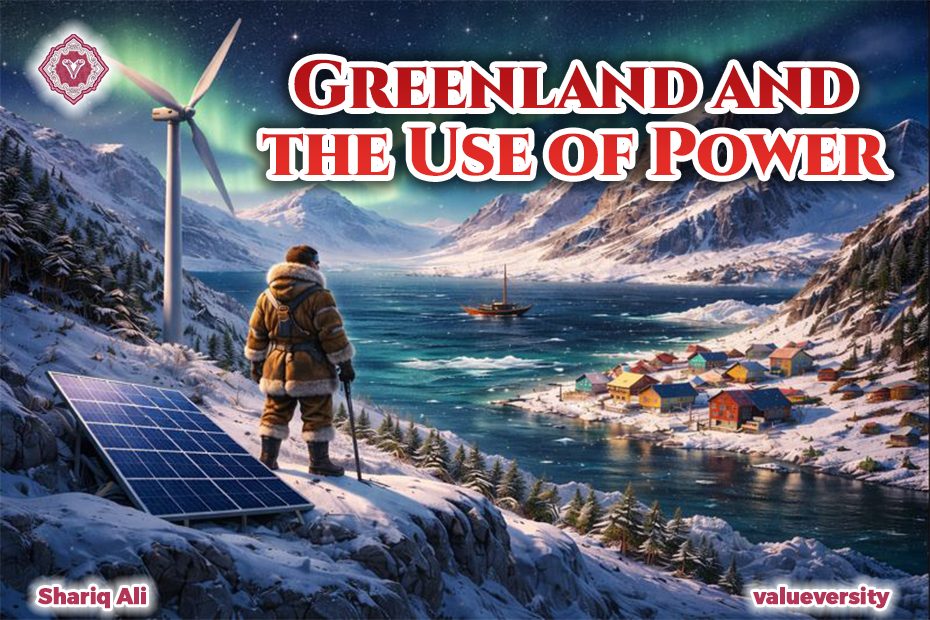
Greenland and the Use of Power
Shariq Ali
Valueversity
At the breakfast table, the conversation suddenly turned toward my son’s university project. After completing his Master’s degree in Engineering at the University of Surrey, he has been living a professional life for several years now.
Mona and I became attentive. Holding a cup of tea in his hand, with a gentle smile glowing in the light coming through the window, he recalled a memory from the past. The subject of his final-year Master’s project, developed with his team, was to make renewable energy accessible for the indigenous people of Greenland—the Inuit.
Greenland is one of the most geographically challenging regions in the world. Extreme cold, ice stretching in every direction, and an area covering nearly two million square miles, yet home to only around sixty thousand people. It is the largest island in the world by area, but almost eighty percent of it is covered by a massive, permanent ice sheet. If this ice were ever to melt completely, global sea levels could rise by several meters.
This is precisely why Greenland holds a central place in global discussions on climate change.
Most settlements here are located along the coast, as the interior is almost impossible for human habitation. Another fascinating fact is that during summer, the sun does not set for several weeks, while in winter daylight is limited to just a few hours.
This unusual cycle of day and night presents a major challenge for engineers—but also an important opportunity.
The aim of this academic project was not merely to produce a theoretical model on paper, but to seek a solution to a real human problem:
How can energy be generated in such remote regions where neither large industries exist nor heavy investment is feasible?
The team worked on generating electricity from strong Arctic winds, utilizing limited yet consistently available sunlight, and designing low-cost hybrid systems—systems that would be reliable for local communities and also harmonious with nature.
The life of the Inuit is built around hunting, fishing, and survival within limited resources. This way of life teaches us that progress does not mean colliding with nature, but rather learning the art of moving alongside it.
This entire conversation made me realize that modern education—especially engineering—teaches students that the world is a single whole and that human problems are shared. When projects are designed with regions like Greenland in mind, stepping beyond the classroom, education ceases to be mere textbook knowledge and instead becomes a collective human responsibility.