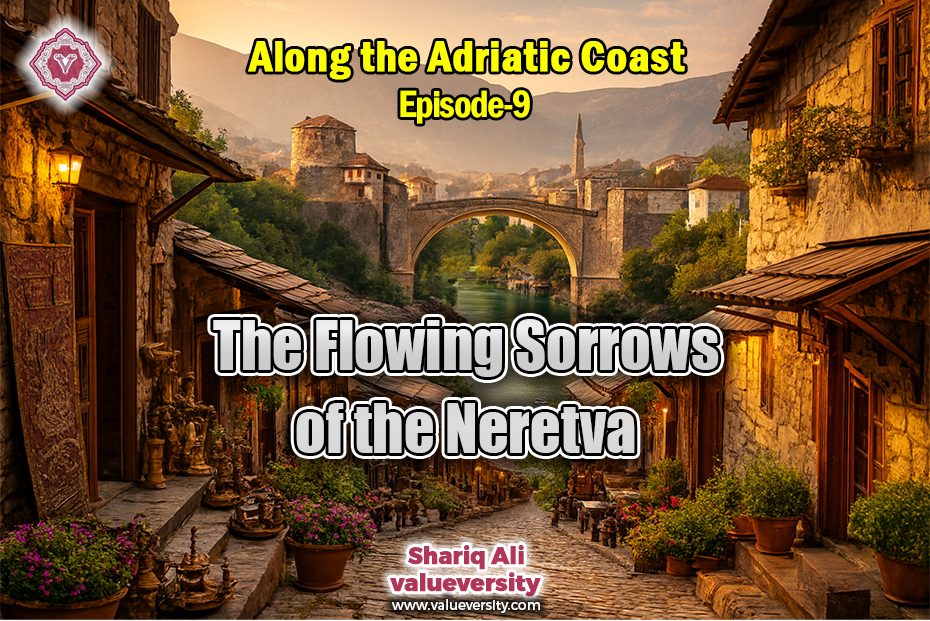
The Flowing Sorrows of the Neretva —Along the Adriatic Coast
Episode Nine
Shariq Ali
Valueversity
After spending some time wandering through the old streets of Mostar, when we returned once again to the Stari Most Bridge, I stood there quietly for a while, gazing down at the greenish-turquoise waters of the River Neretva flowing beneath. For centuries, this river has carried countless stories in its current.
This single-arch, crescent-shaped bridge built over the river is barely fifty to sixty feet long and is constructed from ancient stone. Its perfectly balanced proportions, graceful curvature, and the dignified weight of centuries resting upon it turn the simple act of crossing into an unforgettable experience.
Below, tourists and local residents sat along the riverbanks; boats drifted gently across the water, and here and there the hum of a passing motorboat broke the silence. Bathed in golden sunlight, the entire scene shimmered.
Against such beauty, the thought that innocent human blood had once been spilled here felt almost unbelievable. My mind slowly turned away from the pleasant bustle of the present and wandered into the alleys of the past.
The bridge was completed in 1566, during the golden era of the Ottoman Empire under Sultan Suleiman the Magnificent. It was not built of stone alone, but of promises of connection, trust, and union between cultures.
Empires later changed hands: Austro-Hungarian rule arrived, the shadows of world wars passed over, Yugoslavia’s communist era unfolded, and then, in the 1990s, the violent divisions of nationalism and religion left this bridge soaked in blood.
Standing there, I was reminded of the novel The Bridge on the Drina, written by the Yugoslav author Ivo Andrić, for which he was awarded the Nobel Prize in Literature in 1961. The novel revolves around the Mehmed Paša Sokolović Bridge in the Bosnian town of Višegrad—a bridge also built in the sixteenth century during the Ottoman period.
The book is not the story of a single character, but a chronicle of centuries of Bosnian history: the Ottoman era, Austro-Hungarian rule, religious and ethnic tensions, and the quiet lives of ordinary people. Although that bridge is different from Mostar’s Stari Most, both stand as symbols of the Balkans’ complex history and of Ottoman engineering.
Mostar is a city that once witnessed harmony between mosques and Roman Catholic churches. Later, it was torn apart along lines of religion and ethnicity. Hatred and division replaced human affection and coexistence.
A city where relationships were once formed through shared language, neighborhoods, and neighborliness was fractured by nationality and religion.
Yet slowly, those wounds are healing.
The lively mix of communities in the bazaars, the minarets of mosques, the towers of churches, and the interwoven lives in the streets awaken a new sense of hope.
Our guide told us that interfaith marriages are once again becoming common here. Human beings have begun to reconnect with one another.
My silence offered the River Neretva a quiet, hopeful reassurance, and I walked gently toward the Mostar coach station.
After completing our visit to Mostar, we once again took our seats in the black luxury coach. Our next destination was the Kravica Waterfalls. The coach gradually left the city behind and entered the lush rural landscapes of Herzegovina.
These waterfalls are part of the natural flow of the Trebižat River and have, for centuries, been an essential element of the region’s geographical identity. From the Ottoman era onward, this area has served as a natural source of water and agriculture for the local population.
As the coach drew closer, the presence of moisture, greenery, and flowing water became more palpable. We sensed that yet another breathtaking spectacle of nature awaited us ahead…
To be continued.