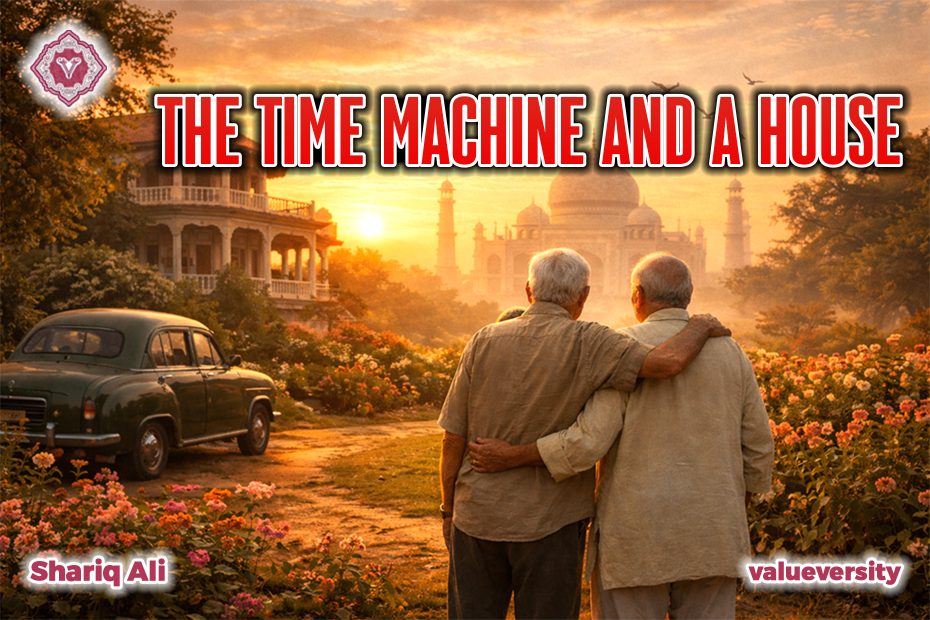
The Time Machine and a House
Shariq Ali
Valueversity
A time machine is not available at present.
And even if it were ever invented, people like us would probably have to wait a very long time before getting access to it.
But there is a remarkably simple solution to this problem.
If you wish to relive the pleasant moments of the past,
meet an old friend.
When I reached the office of the Sindh Institute of Child Health,
located near the Mausoleum of Quaid-e-Azam,
the Executive Director was busy.
Once he found some respite from administrative responsibilities and files,
we both looked at each other with that same old, familiar gaze.
An unforced smile appeared.
And it felt as if we had both boarded a time machine together.
We travelled forty to forty-five years back,
to our days in medical school.
The wrinkles on our faces seemed to dissolve.
In our conversation and laughter, the freshness of youth returned.
Years of distance,
living in different countries,
and the busyness of private lives
all seemed to melt away.
Strolling through the streets of Bahadurabad,
the preparations for oral examinations came alive again.
On the college staircases,
the confidences of heartfelt emotions returned.
Drunk on the virtual reality of youth,
we were lost in reverie when Jamal said,
“Come, let me show you a house.”
We sat in an official vehicle
and stopped in front of an old yet dignified house
near the Mausoleum of Quaid-e-Azam.
This was TDF Ghar.
While buying the tickets,
the mischief of our college days resurfaced,
and I began looking around here and there.
A ticket costing one hundred and fifty rupees was no issue,
but respecting the tradition of friendship was essential.
That innocent youthful attempt to outsmart succeeded—
Jamal bought both tickets.
TDF Ghar
is a residential house in Karachi,
built in the 1930s,
which once belonged to a prosperous middle-class urban family.
It was a time when Karachi
was an emerging, civilized, and peaceful coastal city of British India.
The walls of this house
witnessed the social transformations of the subcontinent,
the creation of Pakistan,
and the forming and shattering of dreams of a new country.
Later, The Dawood Foundation
restored it with taste and dignity,
giving it the form of a living museum.
As soon as one enters the house,
it feels as though time has slowed down.
Forgotten old-style furniture,
a gramophone,
a Singer sewing machine,
a rotary-dial telephone,
tea cups from the 1960s and 1970s,
and wooden cupboards—
these are not merely objects,
but living stories of an entire era’s way of life.
These are the stories
lived by those who settled in this city after the Partition of India,
when they made Karachi
their new home.
The décor of the house is simple yet refined.
Red and black mosaic floors,
high ceilings,
airy verandas,
and sturdy wooden doors
reflect the architecture of that era.
Every room
is arranged with deliberate care,
as if each object is quietly telling its own story.
Each room seems to represent a phase of Karachi’s past,
when this city
was a confluence of cultures, languages,
and dreams.
This living museum seems to say
that Partition was not only of borders,
but also of memories,
ways of living,
culture,
and identity.
When we reached the rooftop,
we both stood silently for a while.
In front of us, the Mausoleum of Quaid-e-Azam
stood with complete dignity and calm.
I had never seen the mausoleum
in such a majestic light before.
It was a strange confluence of place.
On one side,
the Quaid’s mausoleum gleaming in white marble,
as if a symbol of his dream;
and on the other side, beneath our feet,
the tangible form of this house—
the lives lived by those
who devoted their existence
to the realization of those dreams,
their ways of living,
their scattered desires,
and their unfulfilled hopes.
We looked at each other.
A long journey had been covered.
Many dreams
had taken the shape of reality,
and some remained incomplete—
especially the dream of love
and social justice.
TDF Ghar
reminds us
that cities are not made of buildings alone,
but come into being through human aspirations,
dreams,
and collective memory.