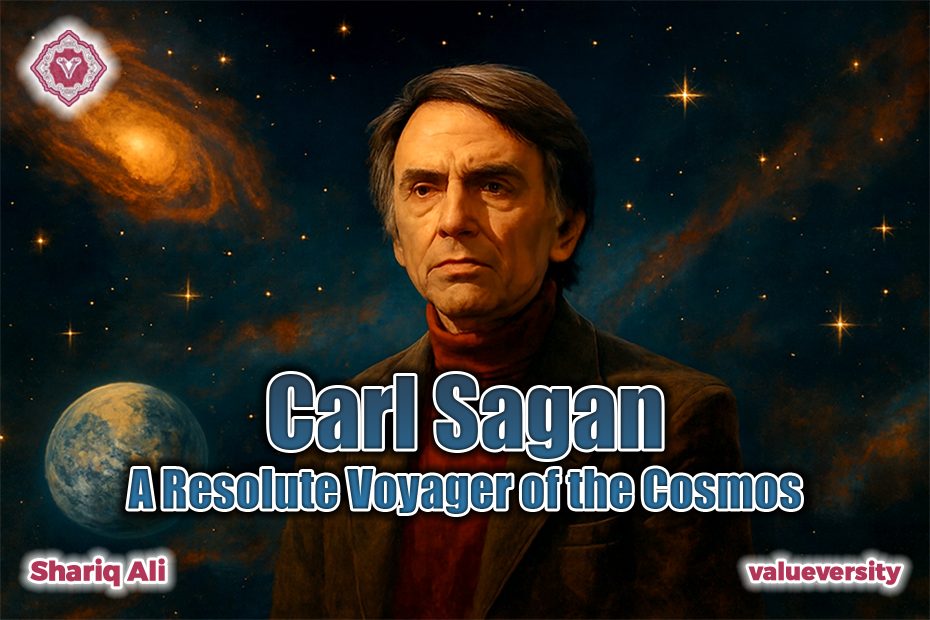
Carl Sagan: A Resolute Voyager of the Cosmos
Shariq Ali
Valueversity
The world first heard the story of the universe in a clear, accessible voice through Carl Sagan—a voice calm, friendly, and filled with hope. Viewers of Cosmos began to feel that the universe was not a distant, cold reality, but a familiar and deeply human story.
Yet behind that voice stood a man quietly battling a severe, life-threatening illness.
In 1979, as Cosmos was on its way to becoming the world’s greatest scientific television series, Carl Sagan was undergoing treatment for a deadly blood disorder. Every morning began with immune infusions in the hospital; a few hours later, he would be standing in the studio, speaking about the universe. The audience saw only knowledge and calm—but behind the scenes was a tired yet extraordinarily determined human being.
In six months, he traveled to thirteen countries—Greece, Egypt, India, and regions where humanity’s astronomical consciousness first took shape. Despite this exhausting schedule, Sagan spent his nights rewriting scripts. When doctors advised him to rest, he would smile and say:
Science must be correct.
For him, science was not merely a collection of facts—it was a guarantee of humanity’s future.
Notes kept by his wife and intellectual partner, Ann Druyan, bear silent witness to that period. In one simple line, the whole man is captured:
“Morning at the hospital, afternoon in the studio—Carl is tired, but determined.”
The famous message of Pale Blue Dot was likely recorded during some of the most difficult moments of his life. Repeated reflection on every sentence, extraordinary care for tone, pace, and pauses—all of it driven by a deep sense of responsibility to convey truth with complete integrity.
For Carl Sagan, the universe was never something distant. He saw it as a living reality, intertwined with human breath. That is why, despite illness, fatigue, and weakness, he never failed to deliver this message:
We are bound to live together on this tiny blue dot. It is the home of all our dreams and hopes.
Cosmos was the expression of this very idea—not merely a television series, but a serious and honest effort to awaken human consciousness.